Barcelona was definitely a bucket list destination for me and it did not disappoint. It is the vibrant and historical home of the most stunning architectural styles ranging from Gothic structures to Gaudi wonders. Barcelona is cosmopolitan and has an international feel with plenty of great restaurants, tapas, nightlife, parks and public areas.
I have visited Barcelona twice for a total of six days, and I still feel like there is so much more to see here. This gives me the excuse to go back!
Here is what caught my eye, enjoy!
Do you like the images posted?
Click here to explore the shop.
Interesting architecture with the use of bright colors
From 1882 up until his death in 1926, Catalan Art Nouveau master Antoni Gaudi devoted himself to the construction of the overly ornately carved La Sagrada Familia.
The basilica is divided into three facades and this is from the passion facade, representing the passion and the death of Jesus.
While the church does feature Gothic elements, there are plenty of unconventional details that deviate from the norm throughout, resulting in an eye-catching structure that is entirely one of a kind. Gaudi’s La Sagrada Familia is probably the most unique church in the world.
This is just a small section of the enormous amount of detailed carving that covers the exterior of the church.
Here is another statue on the passion facade.
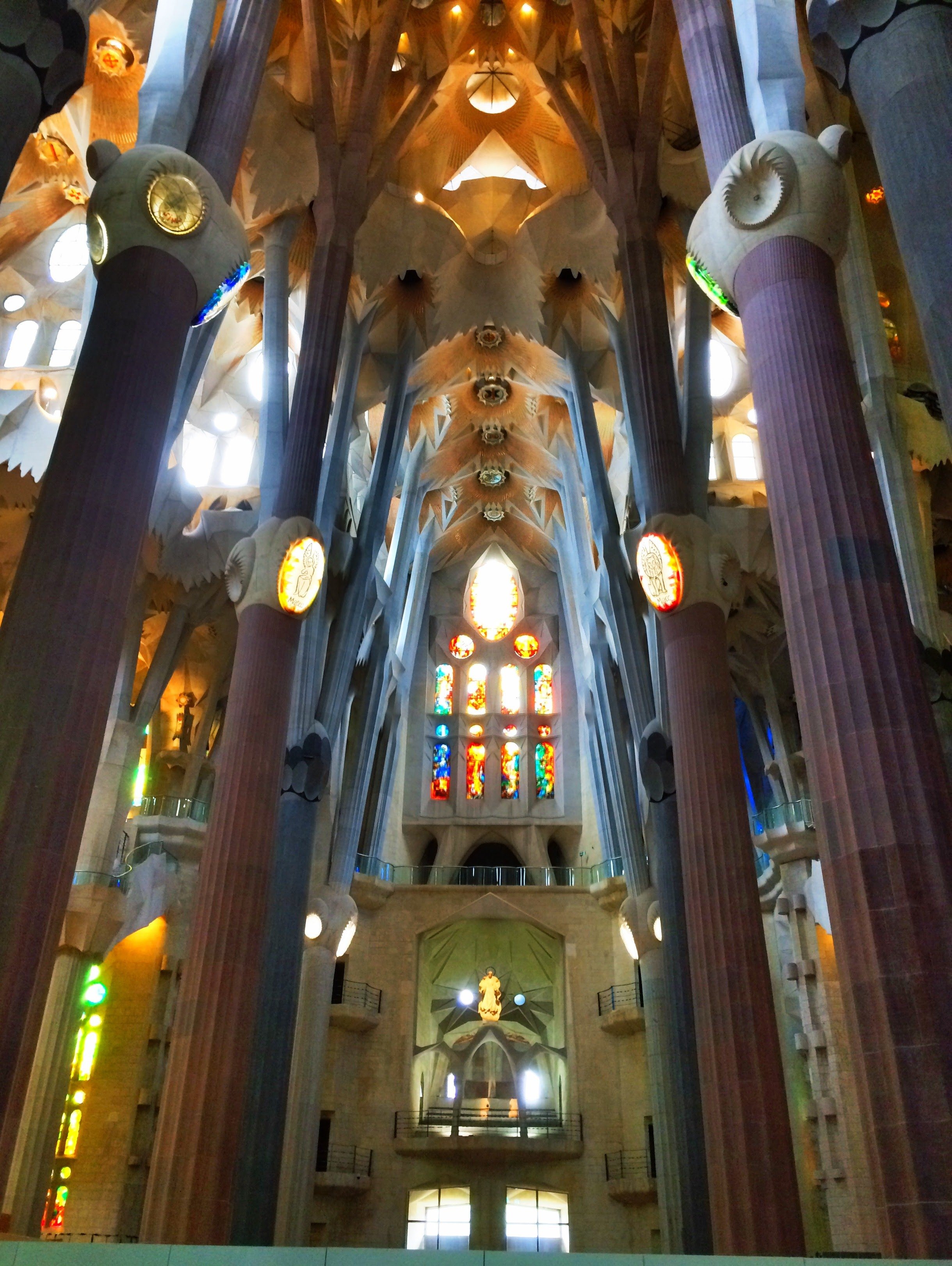
I was a little surprised at the unconventionally modern interior with stained-glass windows and colored lights shining on the walls and floors.
The intricate ceiling is striking, with smooth nearly white stone columns, and the rows of vibrant stained-glass windows.
Unconventional floating crucifix sculpture hangs above the main altar.
The 18 spires represent the 12 apostles, the four evangelists, the Virgin Mary and Jesus Christ. When completed, it will be the tallest church in the world.
The church, which is funded by private donations, is still under construction today and is expected to be completed by 2026.
This was the view from a stained-glass window of the Axel Hotel.
The entrance to the Major Joanne Baptista
The palm trees line the street at Plaza Reial.
The rooftop wonderland of Gaudi’s La Pedera, is an essential place to visit to learn about Antoni Gaudi’s work.
Ventilation towers and chimneys on the rooftop oasis of La Pedera
Inside La Pedera apartment
The Palau Nacional is a beautiful imposing building that offers views over Barcelona.
The Barcelona Magic Montjuic Fountains
The pools and waterfalls of Barcelona Magic Montjuic Fountains
The Barcelona Magic Montjuic Fountains were built for the second Expo. There are scheduled sound and light shows that are worth checking out.
Stunning fortress-like architecture
Turrets, towers and spires
The Gothic Quarter is a lively area with trendy cafes, cool little boutiques, restaurants and some night hotspots.
Strolling down Las Rambles, take notice, hanging outside the Casa Bruno Cuadros, is this painted dragon sculpture with umbrella.
This is one of the counters inside Las Rambles’ La Boqueria. Las Ramblas is a series of bustling pedestrian-only narrow streets and alleys, situated in the middle of the city, with cafes, flower stalls, souvenir shops, restaurants, nightclub, street performers, beautiful architecture, and active marketplace. It is a great place to just sit and people-watch.
Las Ramblas treats
Antonio Gaudi is considered, by most, to be the “face” of Barcelona architecture. He was influenced by natural forms.
The Montjuic Cable Car runs to Montjuic Castle.
The view of Barcelona is framed by tree branches, as seen from the Montjuic Cable Car.
Sun setting at Montjuic Castle, one of the highest view points in Barcelona
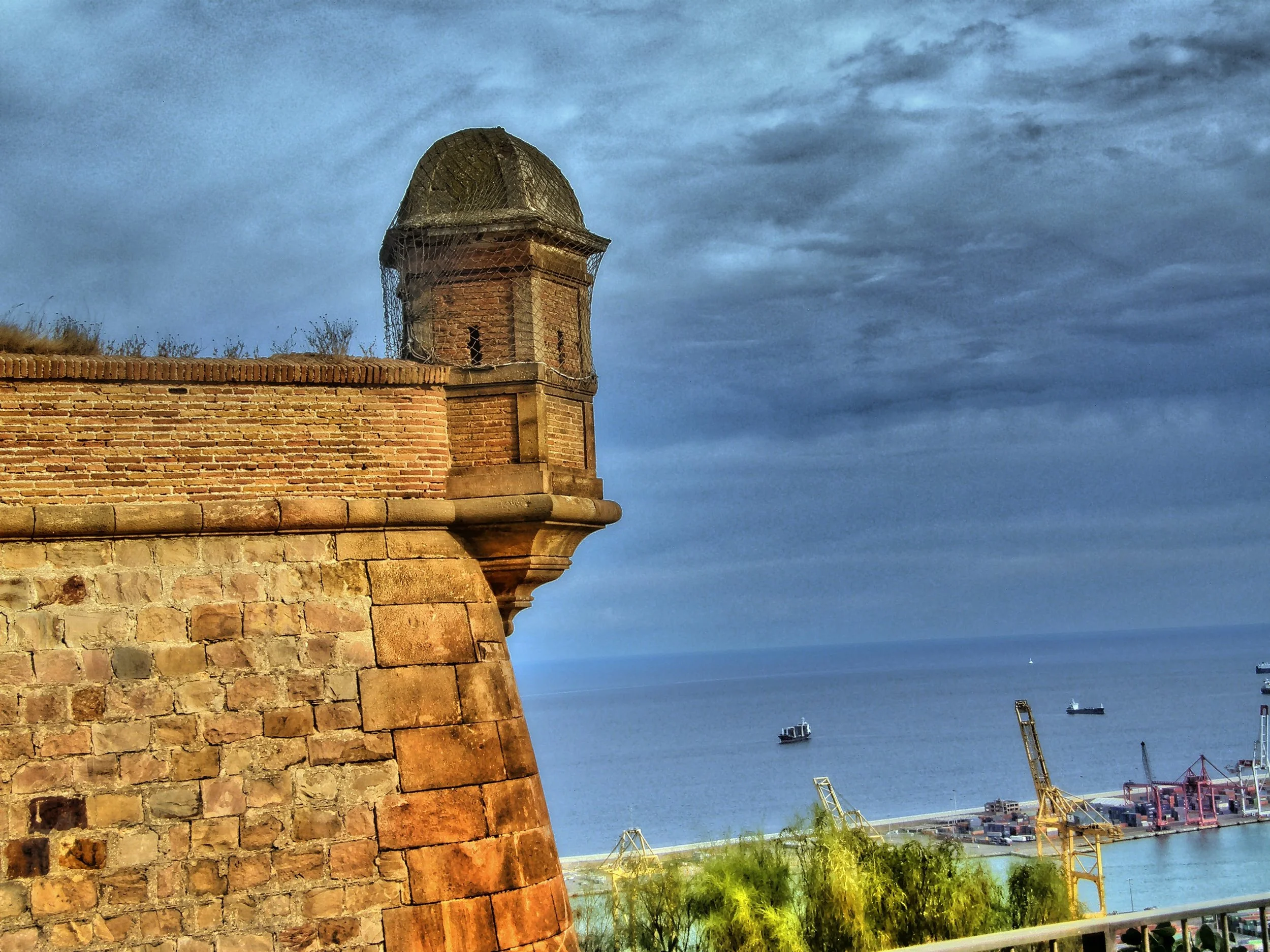
Montjuic Castle turret
Stairs leading to the Montjuic Castle
Montjuic is a relatively green space spread over a small hill.
Looking out over the seaport of Barcelona from Montjuic Castle
Axel Hotel rooftop lounges
These angelic statues are on the base of the Christopher Columbus Monument at Port Vell, which was built for the first Expo in 1888.
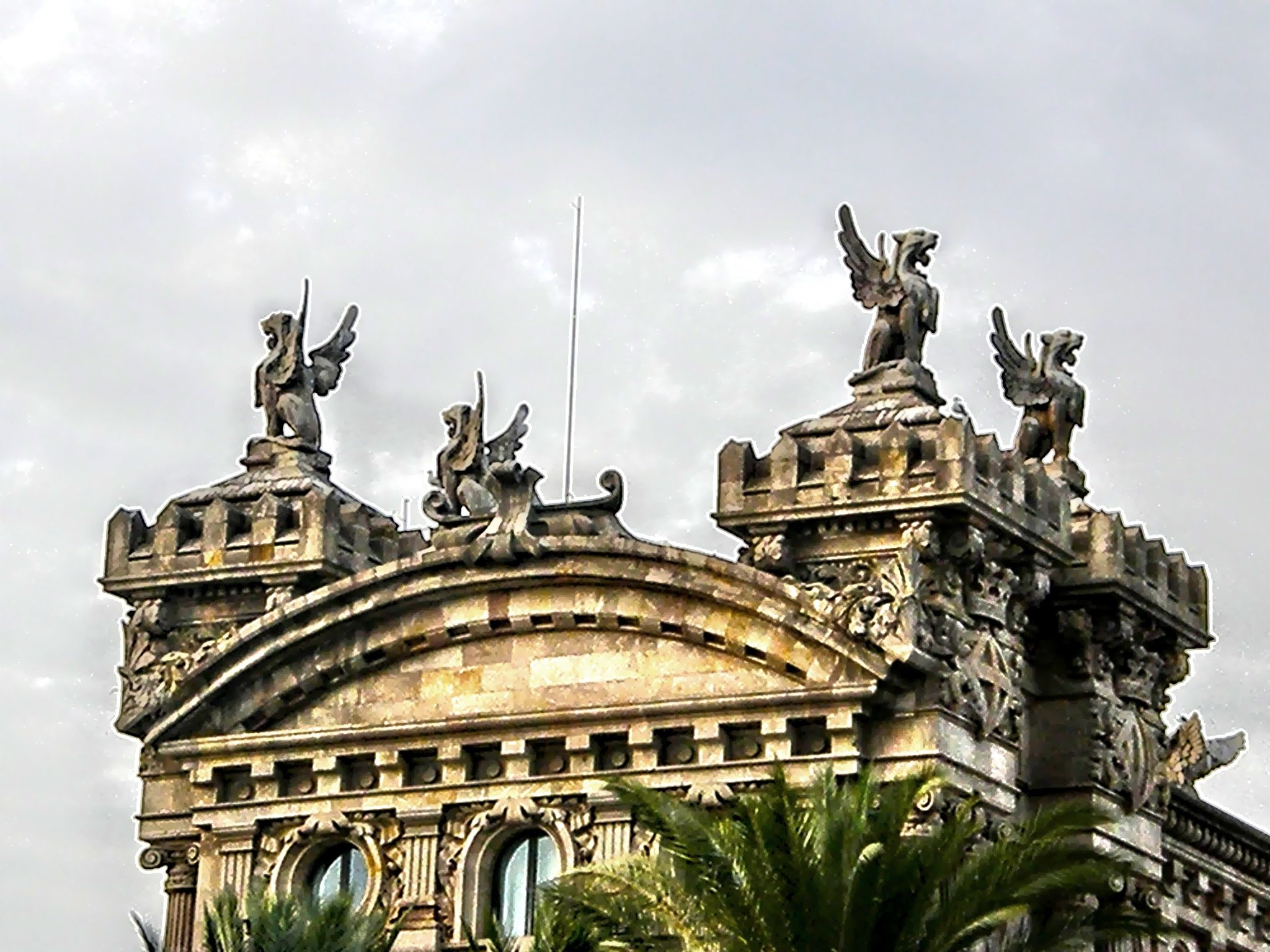
Four stone griffins on a rooftop guard the Port of Barcelona.
Looking down the street as the sun was setting
Decorative facade
Turret
Gaudi’s buildings are sometimes described as whimsical, organic or Seuss-like.
Arches
Gothic-style architecture with decorative turret
Decorative turret
Gaudi’s designs are based on naturally organic shapes and his building are scattered throughout the city.
Tiny balconies and spacious terraces are a huge part of the Barcelona lifestyle.
Gaudi-influenced building entrance
Barcelona has a seamless blend among the variety of architectural styles.
What you should know:
Typically lunch is between 1:00 p.m. and 4:00 p.m.; dinner is between 8:00 p.m.-11:00 p.m.
Many businesses close from 2:00 p.m. - 5:00 p.m. daily, as well as Sundays and public holidays.
The Hop-on Hop-off bus is a great way to get the lay of the land.
There is a large amount of public art, so enjoy it!
There are many restaurant and live performance options.
Barcelona is mostly safe, although there are many reports of pickpockets and bag snatches, so be aware of your surroundings.
The currency is the Euro.
Be careful of large fees to convert currency.
You will need a valid passport and a travel power adapter if you are from the US.
Many people speak English.
It is a walkable city.
People are friendly and helpful.
Most museums are closed on Mondays.
Tipping is not generally expected.