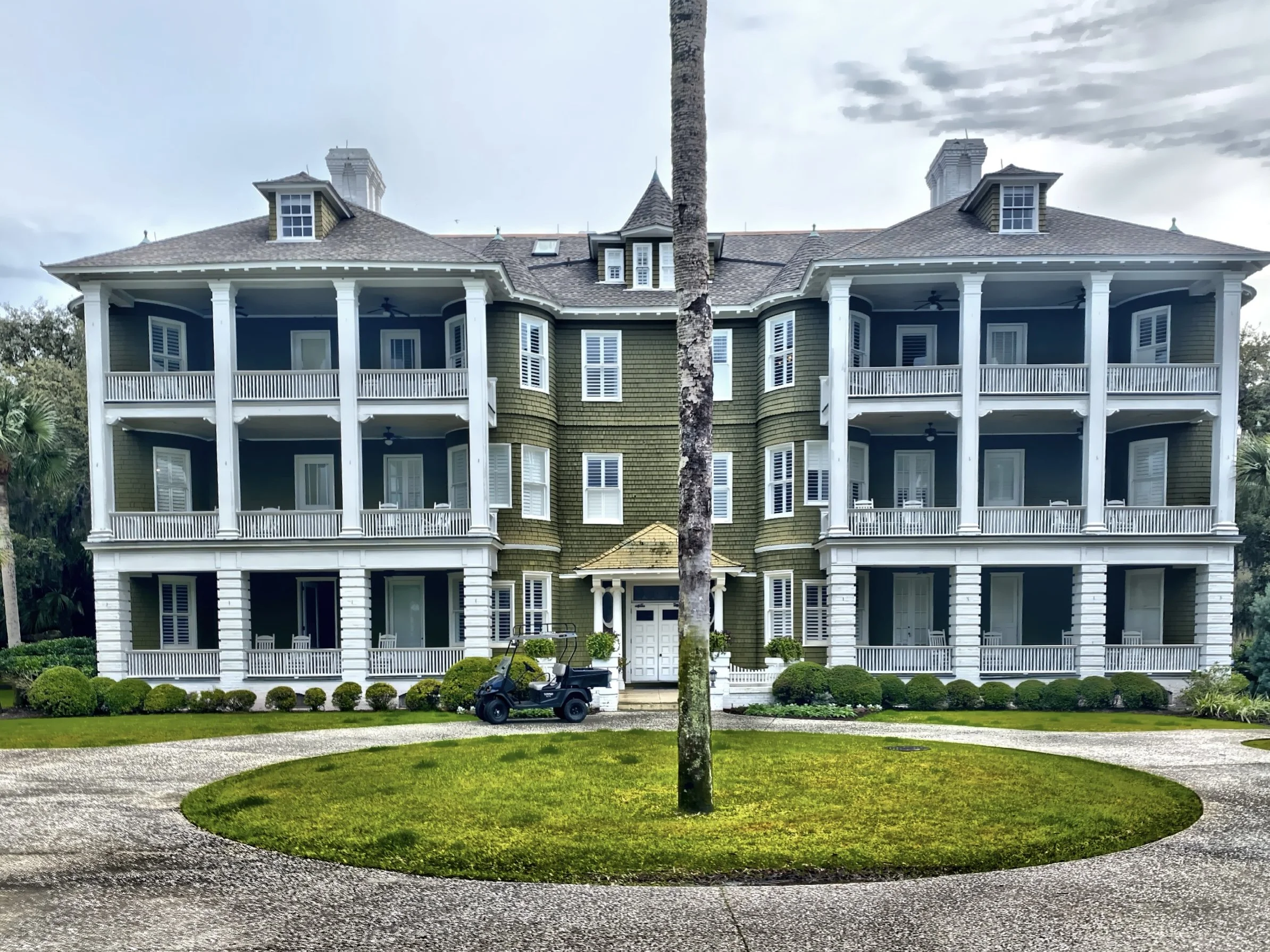
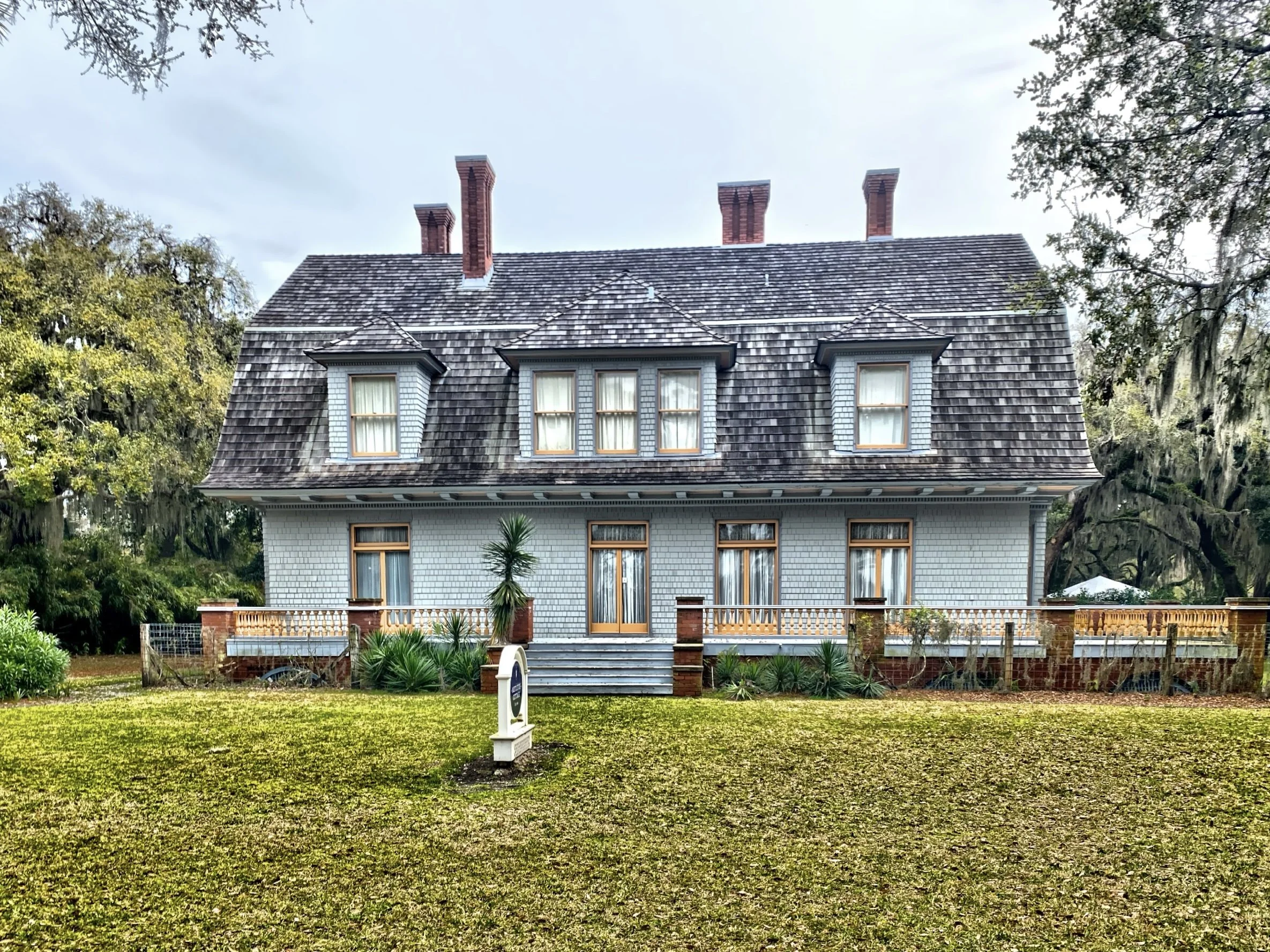
The Jekyll Island Club membership was like a ‘Who’s Who’ of the the late 19th and early 20th centuries and represented 1/6th of the world’s wealth at the time including Rockefeller’s, Vanderbilts, Pulitzers, Morgans, Gould and more. The island was purchased in 1886 as a private winter retreat for many of America’s wealthiest families. Members of the Club built cottages for their families to enjoy the island’s natural landscape and mild winters. The unusual thing about most of these cottage, is that they were built without a kitchen or with only a very small one. This was because the members and their guests generally took their meals at the club. The resort had everything that was needed, a dairy, library, water tower, windmill, croquet lawn, servant dormitories, ward and club dock, stables, chauffeurs’ housing, staff dining room, commissary, indoor and outdoor tennis.
Here is what caught my eye, I hope you enjoy!
Villa Marianna was built in 1928 for railroad executive Frank Miller Gould. This was the last cottage to be built at the Club.
.
The Gould Casino & Tennis Court was built 1902 as a recreation complex by Edwin Gould Sr. on a lot adjacent to his home Chichota Cottage.
On January 25, 1915, the first coast-to-coast telephone was made from Jekyll Island.
Do you like the images posted?
Click here to explore the shop.
Villa Oslo was built in 1927 for Walter Jennings and was the only cottage built on the island with a garage. Jennings was an industrialist and president of National Fuel Gas Company and the Jekyll Island Club.
Hollybourne Cottage was built for Charles Stewart Maurice in 1890 and members of the family came to the island every season for 52 years. Unlike other cottages, Hollybourne had a full kitchen because the family usually arrived before the Club season began each winter.
.
.
.
There is always time for a drink and a bite at The Warf. Back in the day, The Warf saw luxurious pleasure crafts that came to the island suck as JP Morgan’s Corsair II, Astors’ Nourmahal, Vanderbilt’s Alva, and Baker’s Viking.
In 1904, Edwin Gould built Cherokee Cottage with 20 rooms and 6 baths.
.
The Crane Cottage was built in 1917 for Richard Teller Crane Jr., manufacturer of plumbing supplies. The cottage was the most expensive ever built on the island. Another luxury this cottage had was 17 bathrooms.
.
This is the large Queen Anne-style Jekyll Island Clubhouse which was completed in January 1888. In 1897, Henry Hyde, known as the ‘Czar of Jekyll Island’ revived the need for what would be called the Jekyll Island Clubhouse Annex. It featured eight four-bedroom apartments and twenty guest servant rooms in the extension. Apartment owners included John S Kennedy, Charles Lanier, Edmund Hayes and Morris K Jesup.
Designed with turrets, verandas and bay windows the building included a grand dining room, 60 guest rooms, billiards and barber shop.
The clubhouse remained open until 1942 when it closed due to complications from World War II. In 1947 it opened again, but closed in 1971.
Today, it is a luxury hotel and a member of the Historic Hotels of America since 1994.
Built in 1896, Sans Souci is considered, along with the Rembrandt Building in Manhattan, to be one of the first condominiums in the United States. Each of the 6 apartments had a drawing room and three bedrooms and on the fourth floor each apartment had two servant rooms. Original owners included JP Morgan, William Rockefeller, and Henry Hyde.
Jekyll Island was never intended to be ostentatious, it was the opposite of what Newport had become.
Indian Mound Cottage (originally called the McKay Cottage) was built for Gordon McKay, one of the club’s oldest members. He made his fortune by manufacturing a stitching machine that improved shoe and boot creation. William Rockefeller purchased the cottage in 1905, and after renovations in 1913, renamed it after the mound in front of the cottage thought to be and Indian burial mound.
.
When you take the tram tour of the historic district you get to access one of the cottages and the day I visited it was Indian Mound Cottage. These interior images give you an idea of how they lived.
.
.
.
.
.
Mistletoe Cottage was built in 1900 for Henry K Porter. Porter was a businessman and Representative of the United States Congress for Pennsylvania.
Goodyear Cottage was built for lumber and railway man Frank Goodyear Sr. in 1906. Goodyear also founded New Haven, Connecticut, home of Yale University.
The Moss Cottage built in 1896 for William Struthers, Jr a retired owner of a Philadelphia marble works..
.
Morgan indoor tennis center was built in 1930 so members could enjoy tennis regardless of the weather. Named after JP Morgan because he was instrumental in seeing it built.
The DuBignon Cottage is the only building that predates the establishment of the Club. Built in 1884, the house was used as a residence for the Club Superintendent.
The Skeet House was originally built in 1936 outside the historic district and disassembled and reassembled in the current location.
The bookeepers building built in 1900.
Another original club building reused
Some of the island related items in Mosaic, Jekyll Island Museum.
.
.
.
.
.
Some building are still under renovation
Faith Chapel, built in 1904, was used as a non-denominational chapel which contains a Louis Comfort Tiffany window as a memorial to Club president Frederick Bourne in 1921.
Inside Faith Chapel
.
The Great Depression and the World Wars caused the members to abandon their resort island. In 1947, the state of Georgia purchased the island and opened it as a state park one year later. The island’s iconic National Historic Landmark District, a 240-acre site filled with 34 historic structures is open to the public. Walk the trails, take a tour, and visit the museum.
What you should know:
You must pay a toll at the entrance to the island.
Tickets for the tram tour can be bought in the museum.
There are walking trails.
Public restrooms are available.
There is plenty of parking available.
People are friendly and helpful.
You could spend up to a couple of hours to an entire day here depending on your level of interest.
For more information: Jekyll Island