Munich is located in the southern German state of Bavaria, and is also the capital and home to centuries-old buildings. It is known for its annual Oktoberfest celebration, beer halls and gardens. Munich, means “home of the monks”, and this refers to the origins at the Benedictine monastery at Tegernsee, founded around 746.
Altstadt (Old Town) has a central square called Marienplatz, which is a compact Old Town pedestrian square. It has been the city center square since the 12th century and is named for the Marian column that was raised here in the 17th century. Marienplatz square contains the landmark Neo-Gothic Neues Rathaus (New Town Hall) and the popular glockenspiel, that chimes and reenacts stories from the 16th century.
This is what caught my eye, I hope you enjoy it!
Do you like the images posted?
Click here to explore the shop.
The Munich National Theater on Max-Joseph-Platz is one of Europe’s top opera houses originally built in 1825 and rebuilt in the 1960’s after war damage.
The columns of the historic National Theater in Max-Joseph-Platz
The entrace of Alois-Dallmayr restaurant
The entrance to the Rathskeller restaurant in the Marienplatz
This building, with the tower, is the old Town Hall and looks newer than the New Town Hall, yet it is is 400 years older.
The impressive New Town Hall was built in Marienplatz in 1905. You can see the 280-foot tall central glockenspiel tower complete with 43 bells and mechanical figures that perform a 15-minute long performance at 11:00 a.m., 12:00 and 5:00 p.m. The performance is inspired by the tournaments that were held in the square in the Middle Ages.
The elaborately decorated New Town Hall contains 400 rooms
Over the courtyard entrance of the New Town Hall
Architectural details of the New Town Hall from inside the courtyard
The base of the Marian column, erected in 1638 to celebrate the end of Swedish occupation during the Thirty Years’ War. Shown here are two of the four statues of puttos, created by Ferdinand Merman, depicting fights with different beasts, symbolizing the city’s overcoming adversities, the dragon represents famine and the serpent representing heresy.
Architectural details on a corner of a building in Marienplatz
More of the stunning architectural details of the city’s buildings
Beer kegs being delivered to a beer garden
The gothic-style pair of towers of the Frauenkirche (Church of Our Lady) define Munich’s skyline and are a Munich landmark
St. Peter’s Church is Munich’s oldest church, first built at the end of the 1100’s but destroyed by fire in 1347 and reconstruction has left it with Renaissance and Baroque elements.
Inside St. Peter’s Church
Browsing the stalls of the Vikualienmarkt is a feast for the senses.
The bronze statue of Juliet, from Shakespeare’s “Romeo and Juliet” near Old Town Hall in Marienplatz. The sculpture was a gift from the city of Verona in 1974.
A pedestrian bridge between two buildings
Bicycles parked outside of a another beautiful building
More of the city’s architecture
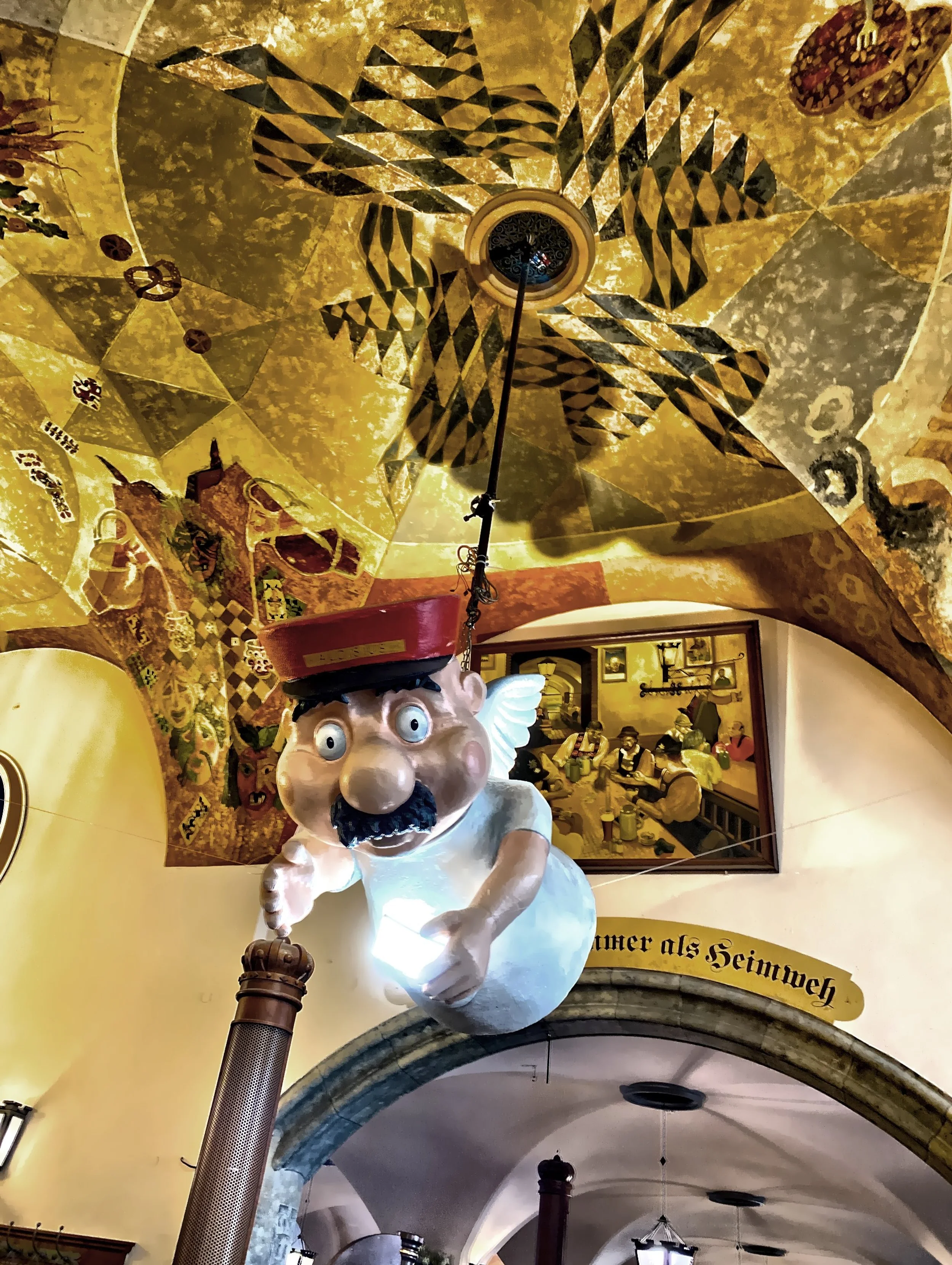
Inside the famed Hofbrauhaus beer hall, founded in 1589.
Delivery bicycle outside a local restaurant
The clock tower of the Old Town Hall
An entrance door details inside the courtyard of the New Town Hall courtyard.
Another view of the New Town Hall
What you should know:
You will need a valid passport and a travel power adapter if you are from the US.
The currency used is the Euro (EU).
Many people speak English.
People are friendly and helpful.
The Old Town is walkable.
You could spend a couple of hours to a few days exploring here.
There are many restaurant and beer gardens.
Tipping is not generally expected.
There is a charge to use most public restroom (around 50 EU).